Coaching Conversations with Women Leaders – Chapter 3: Being Heard, Not Just Listened To

The feminine mindset draws clear distinctions between being listened to and being heard.  There are a myriad of listening techniques that can be mechanically practiced and enhanced.  Organizations invest time and resources in practicing/developing these skills in their leaders.  However, left brained listening that focuses on words, facts, the logic of a conversation, and validates through restating what has been said, is not the same as feeling validated through active, empathetic, and contextual listening.  Someone who feels heard feels the listener has suspended the knowing voice, and carries a frame that allows the listener to be able to detect the underlying emotions, feelings, and context or situational factors surrounding the words.  Great leaders are able to connect at an emotional level and validate what others are feeling as well as the context.

One of the most powerful examples that vividly demonstrates the difference between being listened to versus being heard occurred during the 1992 Presidential debate between Bill Clinton, George Bush Sr., and Ross Perot. A young African American woman asked “how has the national debt personally affected each of your lives, and if it hasn’t, how can you honestly find a cure for the economic problems of the common people, if you have no experience in what’s ailing them?” President Bush was visibly thrown off by the question. His body language and tone signaled annoyance towards the questioner.   After several attempts at understanding the question, he answered with a logic-based approach, focusing on facts selected to persuade the questioner that the national debt was a higher order concept that could not really be linked to individual lives.  He also attempted to use the power of his office to convince her by saying “you ought to be in the White House for a day and hear what I hear, and see what I see, and read the mail I read, and touch the people that I touch from time to time…” which further disconnected him from his audience. He attempted to convince the audience that although he has not personally experienced financial hardship, this did not mean that he does not understand it. At one point he exacerbated a bad moment by nervously looking at his watch. It made him seem even more disconnected. His answers all had an air of talking down and lecturing to the audience. He did not exhibit any visible non-verbal cues that showed an emotional connection with the questioner or an understanding of the situation/context that surrounded her life.

In stark contrast, President Clinton moved toward the questioner and established eye contact and a non-verbal connection. He validated her by demonstrating that her question was important, and given his own background and circumstances, he could empathize with her and the challenges that she faced.  Next, he offered her hope by providing a supportive shoulder as well as a path forward. Irrespective of one’s political affiliation, this moment captured in the video below is recognized by political pundits from both parties as a defining and seminal moment in favor of President Clinton in the 1992 Presidential debates. A CBS News poll found that 53 percent of US voters thought so, versus 25 percent who favored Bush.

Research conducted by John Gottman in his groundbreaking work on marriage and relationships shows that one of the most important factors in the success of relationships is the extent to which one or both of the partners feel that he/she is “heard” and validated by the other. 1

In the work setting, this translates into a leadership style that demonstrates genuine care and attention to the emotional and affective aspects. I am continuously amazed at how shocked and surprised leaders are when they receive the results of their employee surveys. In many cases, the areas with the lowest scores include the extent to which:

  • Employees feel their perspectives and opinions are valued and considered in decision making
  • Management genuinely cares and invests in their professional and personal development
  • There is transparency in organizational and leader communication
  • Leaders make themselves available and are approachable

The common thread running across all of these areas is the employee perception of not being heard by their leaders. The feminine mindset places high value on the ability of a leader to really hear their employees. Here are some indicators:

  1. Can the leader pick up on the real message that their employee is communicating to them? Not only the spoken words, but the feelings and emotions that surround those words – Empathetic Listening
  2. Can the leader understand the context that is surrounding the spoken words?  For example, the culture in which the employee was raised – Contextual Listening
  3. Can the leader put him or herself in the shoes of the employee at that particular point in their career, and feel the currents that are driving the employee’s thoughts and feelings?
  4. What are the non-verbal cues, such as the body language and tone of the leader, as he or she is listening? (Once more, notice President Clinton’s non-verbal communication while answering the question – http://www.youtube.com/watch?v=7ffbFvKlWqE)
  5. What are the ways in which the leader shows understanding and empathy in regards to what their colleague is telling them?

Questions for our online conversation

  • Have you worked with leaders who were either especially adept or incompetent at making you feel like you were heard? What were the characteristics of these leaders and their listening?
  • How did it make you feel?
  • How did it shape you and your leadership, if at all?


1. Gottman JM, Silver N. The Seven Principles for Making Marriage Work: A Practical Guide from the Country’s Foremost Relationship Expert. Three Rivers Press; 2000.
Coaching Conversations with Women Leaders – Chapter 2: Honoring the Whole Self

In the last chapter I described the qualities of anima (female energy) and animus (male energy).  I also suggested that leaders who can integrate both into their leadership style will be more successful leaders in the 21st century. However, the primary question that many leaders return to is how does all of this translate into results in the work environment? Furthermore, what are the strategies that organizations should pursue in order to honor and foster this balance?

In the following chapter, I will first provide more insight into this feminine or anima mindset, and then share additional examples of organizational strategies that high performing companies such as Trader Joe’s and Google have employed to achieve this balance.
 

Chapter 2: Honoring the Whole Self

As mentioned in Chapter 1, the anima (feminine) mindset is the generative and holistic energy required to develop and nurture the social fabric of the environment. When one finds him or herself in this anima mindset, an inner voice might say the following:

“see me, the smart and successful leader,”

“see me, a great mom,”

“see me, the energetic volunteer in schools and community,”

“see me, the loving and grateful daughter that will take care of my elderly parents,”

“see me, the social architect that connects the family and friends,“

“see me, taking care of my health and appearance so that I can feel good about myself and lead and take care of others…”

The feminine mindset does not see these as disjointed presences with solid boundaries.  Rather, it views these components as an interwoven tapestry of thoughts and feelings with a profound impact on personal happiness and leadership effectiveness.

Feminine cultures encourage personal stories and celebrate the make-up and preferences of people. These cultures consider knowing individuals on the team, and connecting with each an essential aspect of leadership. Cultures that only emphasize business acumen, presence and a “just the facts please…” mentality, diminish the social and emotional intelligence and the creativity needed to navigate and win in a competitive and challenging world. Leaders with a healthy balance of anima who work in organizational cultures denying or preventing them from expressing their “whole self” report earlier signs of loss in motivation, loss of leadership, resonance, and eventual burn out and separation from their organizations.

Leaders with the feminine mindset notice when organizations take active steps to make it possible for them to feel whole.  For example, organizations that sponsor and genuinely engage in causes that benefit communities and societies are seen as being more interesting places to work. Organizations that take an active interest in the spouses and children of their employees set a platform for success. Examples include:

  • Spouses being interviewed prior to expatriate assignments to help them understand the implications of international assignments for them and their children, and what can be done to help orient them and make the transition as painless as possible
  • Provision of onsite childcare allowing better integration of leadership capabilities with care giving needs

Feminine cultures are also more open to multidisciplinary and integrative thinking. These organizations have softer boundaries regarding career planning and roles/responsibilities. A more informal communication style is practiced, and decision making is less rigid and hierarchical.  These organizations operate primarily in the service of great ideas/innovation, customers, and their employees.  Trader Joe’s, the retail food chain, is a great example of this concept.

Mallinger and Rossy report the following from their study of Trader Joe’s:

The Crew members” (the moniker for store employees) are selected, in part, because of their expressed enthusiasm and energy. Training includes skills in communication, teamwork, leadership, and product knowledge. Crew members handle a multitude of responsibilities including, cashier, stocker, and customer interface, and are evaluated on a quarterly basis. Turnover among full-time crew is 4 percent yearly, substantially below that of traditional supermarkets. The managerial structure is relatively flat. Crew members report to the “first mate” (assistant store manager), who, in turn, reports to the “captain” (store manager). The store atmosphere is highlighted by a South Seas motif, and crew members often wear Hawaiian shirts and banners throughout the store convey that theme. There is a casual ambiance; new products are identified on chalk boards arranged in key locations. Crew members reported elevated levels of ability to influence, commitment to teamwork, and  level of achievement orientation. They also indicated that they felt empowered to make decisions, were collaborative in their relationship with others, and were motivated to high levels of performance. These characteristics were demonstrated by the extent to which they were enthusiastic, hardworking, outgoing, and team and customer oriented.”1

And here is how Google describes how its culture celebrates the whole self:

“It’s really the people that make Google the kind of company it is. We hire people who are smart and determined, and we favor ability over experience. Although Googlers share common goals and visions for the company, we hail from all walks of life and speak dozens of languages, reflecting the global audience that we serve. And when not at work, Googlers pursue interests ranging from cycling to beekeeping, from Frisbee to foxtrot.

We strive to maintain the open culture often associated with startups, in which everyone is a hands-on contributor and feels comfortable sharing ideas and opinions. In our weekly all-hands (“TGIF”) meetings—not to mention over email or in the cafe—Googlers ask questions directly to Larry, Sergey, and other execs about any number of company issues. Our offices and cafes are designed to encourage interactions between Googlers within and across teams, and to spark conversation about work as well as play.” 2

In your experience, what have you observed as examples of specific initiatives or cultural traits that honor the “whole self”?

What are the consequences of not integrating these attributes into the fabric of the organization?

How would you rate your own leadership style with respect to the previous posting on the relationship-based mindset, as well as this chapter regarding leading with the “whole self”?


1. Mallinger M, Rossy G. The Trader Joe’s Experience. Graziadio Business Review. 2007;10(2).
2. Google. Our Culture. Available at: http://www.google.com/about/company/facts/culture/. Accessibility verified August 6, 2012.

Coaching Conversations with Women Leaders – Chapter 1: The Relationship-based Mindset

Coaching Conversations with Women Leaders

First, an acknowledgement.  I fully recognize that there are vast differences in the backgrounds, geographical cultures, work experiences, and chemical/neurological make up of women leaders. In my view, a more accurate driver of effective leadership is the extent to which female leaders can integrate their masculine inner self (animus), and male leaders their feminine inner self (anima) into their leadership style.

The female qualities of anima include attributes such as feelings, emotions, tenderness, relatedness, commitment and fidelity, friendship, love and compassion, imagination, gentleness, creativity, intuition, and a sense of aesthetics. The male qualities of animus include assertiveness, courage, analytical thinking, strength, vitality, decisiveness, a focused attentiveness, and a desire for achievement1.  I believe that leaders who can leverage and balance these qualities will be more successful in leading 21st century organizations.

Additionally, as described by Geert Hofstede, one of the pioneers of intercultural differences, there are cultures/countries that are more masculine, and others that are more feminine. Masculine cultures’ values are competitiveness, assertiveness, materialism, ambition, and power, whereas feminine cultures place more value on relationships and quality of life. In masculine cultures, the differences between gender roles are more dramatic and less fluid than in feminine cultures where men and women have the same values emphasizing modesty and caring. Not surprisingly, Hofstede’s measurements show that the U.S. is one of the highest ranked countries/cultures in masculinity, as well as individualism (the reliance on self rather than the collective). According to Hofstede, these distinctions are a general construct (applicable to men and women).2

Never the less,  in my conversations with hundreds of women leaders, it is impossible not to notice the clear and important differences in the more natural and authentic leadership style of women leaders, and the frustrations they experience when a masculine culture dictates them how they should lead. Furthermore, over time, as more women have entered the labor force and ascended to higher positions, I have noted that their values and beliefs are no longer of the lone wolf variety. These views are clear, intense, and popular – especially with other women who wield significant power. It is therefore critical for 21st century organizations to not only be aware of these views, but also to cultivate and engage with them in positive and productive ways. Talented women who aspire to successful leadership roles have become aware of the organization’s reputation regarding their stance and commitment to incorporating the feminine mindset into the culture. Therefore, organizations that are slow to honor the feminine mindset will be left behind when competing for top women talent and will suffer the consequences.

Over the next few installments, I will share some of the views that consistently emerge in my conversations with women leaders, and the associated frustrations experienced when these views are repressed, blocked, or crushed.

 
Chapter One – The Relationship-based Mindset

Most women are socialized to weave a tapestry of meaningful and often longer-term relationships. This more collaborative orientation assumes a “win-win” outcome, where there is enough room to compromise, find a middle ground, and through the collective intelligence and effort of the team, make the pie bigger for everyone. This is contrasted with a mindset of bringing home the trophy through intense and merciless competition driven by an underlying assumption that there are fixed number of slices in a pie. Women who feel forced or enticed away (by rich compensation and perks) from their more natural and authentic relationship-based views into this competitive frame, report loss in motivation, passivity/gradual check out, addictive ways of obsessively throwing themselves exclusively into work to validate their sense of self-worth and choices, and many other negative symptoms.

The relationship-based leadership style is attentive to how things are done.  Short-term wins at the expense of leaving behind a battlefield of wounded souls and irreparable burned bridges is not an acceptable option. Fostering longer-term relationships is as important as the task at hand.  In fact, they may be more important as the value of these relationships transcend the here and now, and span over the leader’s career.

Here is an example of how being inattentive to the relationship-based leadership style can translate into lost business opportunities. There is a trend by some team development consultancies that advocate “courageous conversations”. This often is an exercise in which members of leadership teams are pushed to publicly declare their concerns and displeasure with one another. These conversations are timed to coincide with a preset timeline for team development, and not necessarily when the team has gone through its journey to achieve trust and camaraderie. The style of conversation is one of confrontation rather than collaboration. Importantly, care is not taken to ensure that these conversations and relationships land in a safe place before the team leaves the room and goes back to conducting its day-to-day work and interactions. Disruptive negative energy is routinely transferred into the work environment and the relationships of team members. Interestingly, we have noted that women leaders or international leaders from more feminine or collectivist cultures rarely engage in this type of activity for team development work or leadership coaching. Those that do, usually feel coerced to do so by their leaders.

What has been your experience with womens’ leadership styles?  Have you also noticed that on average, women leaders naturally prefer a more collaborative style which honors relationship building and creating win-win outcomes? What have been the levels of acceptance or push back by their organizations?  Why?


  1. Stevens A. On Jung. Princeton University Press; 1990.
  2. Hofstede G, Hofstede GJ, Minkov M. Cultures and Organizations: Software of the Mind, 3rd ed. McGraw-Hill; 2010.

Leadership Is a Lonely Gig

Leadership at higher levels of organizations is lonely.  Great leaders are motivated by making the right decisions for the greatest good of the organization and teams they lead.  They find support systems, emotional and spiritual fulfillment, and validation outside of the work setting through family, friends, and external coaches/advisors.  They do not allow personal attachments and individuals or pet projects influence their objectivity and balance.  This requires leaders to regenerate and develop a balance in their lives where work and productivity are important, but not the only source of self-validation and motivation.

There are, however, many leaders who put a great deal of focus on popularity and relentless consensus-building as hallmarks of great leadership.  Yes, as I have written in previous chapters of this blog, great leaders value and look for the collective intelligence of their teams prior to making important decisions.  However, great leaders also carry anchors and compasses that are authentic, visionary, and at times unconventional.  If the leader is overly concerned about achieving consensus amongst all stakeholders and being liked, blessed, or recognized, he will overly compromise.  Imagine a world where our greatest visionaries were focused on popularity.  We would not have many of the disruptive innovations that we enjoy today such as computers, the internet, electricity, and cars.  In the end, after perspectives and opinions have been shared, the leader finds himself in the lonely place of making a decision with the best information at hand, using their intellect and intuition, and hoping for some timely luck. Yes luck.  Look up the greatest innovations and some of the highest impact decisions ever made, and invariably there are situational elements that had a direct impact on their success or failure.

There is a fascinating video clip of President John F. Kennedy and his cabinet debating their response to the intrusion of the Russians into Cuba and their plans to install nuclear missiles.  In this clip, JFK listens carefully to the points of views of both sides.  The hawks, led by General Curtis Lemay and national security advisor McGeorge Bundy, urged retaliation and war.  On the other side, a more cautious approach represented by the blockade was advocated by Robert Kennedy and the secretary of defense, Robert McNamara.  In the end, JFK had to make one of the most important decisions of the 20th century.  At that moment, he was not concerned about pleasing everyone on the cabinet, or being reelected, or how some of his long-time friends and relationships would regard him.  In the end he had to weigh the facts, use his intuitive sense regarding the likely reactions of the First Secretary of the Soviet Union Nikita Khrushchev and his team, stand behind his beliefs, and make the decision that would benefit the greatest number of people. This genre of leadership with a backbone is contrasted with the manner in which some CEO’s and their senior teams make decisions. Their focus is on the short-term reactions of Wall Street, their own short-term wealth and prosperity, and there is seemingly less concern about the longer-term impact of these decisions on the organization. A case in point is the recent safety and quality issues that have resulted in massive financial loss for the pharmaceutical and healthcare organizations.

This quote captures the essence of leadership with courage and backbone:

 “A true leader has the confidence to stand alone, the courage to make tough decisions, and the compassion to listen to the needs of others. He doesn’t set out to be a leader, but becomes one by the quality of his actions and the integrity of his intent. In the end, leaders are much like eagles… they do not flock; you find them one at a time.”   – Unknown

What examples can you share of leaders you know that found themselves in that lonely place and had to make the right decisions? What happened/how did it turn out? What lessons do you think we can take away?

Which Costume To Wear???

Great leaders are able to adjust their style and presence to the realities of the situation.  This important competency is mistakenly looked down upon by some as inauthentic and disingenuous.  However, there is an important distinction between the values and beliefs that a leader embodies and the style/presence that they command in different situations.

Values and beliefs define the core boundaries of a leader and are what followers look for to understand the leader’s vision, ethics, and boundaries.  For example, Sam Walton’s core beliefs were:

  1. Respect for the individual
  2. Service to customers
  3. Striving for excellence

Sam’s actions spoke volumes.  He treated his employees as partners, and empowered them to serve the customers.  He believed in making his employees owners through compensation programs much earlier than most other companies.

Leadership style and presence, on the other hand, are the manners in which a leader communicates and influences his followers.  Since the leader is faced with a variety of scenarios, situations, and constituencies, he must be able to adjust his presence and style.

A great example comes from the Research and Development (R&D) arena.  Early on, bench scientists and R&D specialists are trained and evaluated based on standards of accuracy and fact-based communication.  At this stage in their career, the R&D colleague often selects a low-key approach that favors analytics, sound logic, and a fact based/no-nonsense and non-emotional delivery.  In addition, for the emerging leader in R&D, it is important to respect hierarchy and seniority, as there are academic credentials, industry standing/reputations, and organizational power that are disproportionately assigned to the more senior R&D leaders.  However, as the R&D specialist makes the career turn to general management where they must manage and influence multiple disciplines and leaders, they are often ill prepared for the more extraverted communication style.  Many emerging leaders will confide to their coach that they feel ill at ease speaking up at senior level meetings without having all of the facts to back up their statements.  They go on to say that they are bewildered at the ease with which their colleagues, in areas such as sales and marketing, can state and stand strongly and confidently behind positions that are, in their view, still evolving and not completely supported by data.  They share their frustration at not speaking enough, not having the right level of visibility, and not being noticed for their contributions as leaders in the organization.  They see that colleagues in R&D who are not as competent at the science catapult over them to more senior positions in R&D and the organization simply because, relative to others in R&D, they have better communication, influencing, and political skills.  At this stage in their career, many such emerging R&D leaders decide that they will engage in work that will free them of some of the self-limiting assumptions they carry regarding the importance of having 100% reliability and validity of data prior to leading, and speaking and acting in an undemonstrative and understated manner that focuses purely on facts and logic.  The transition is often challenging, but by no means undoable.  Many have been able to develop a more creative, extraverted, and emotionally appealing persona when in a C-level board meeting than when they are with their R&D colleagues in the lab.

Perhaps the most important skill that a leader needs to develop is the ability to connect with all of their followers in ways they can understand, relate, and be inspired by.  In the words of the sixth president of United States, John Quincy Adams, “If your actions inspire others to dream more, learn more, do more, and become more, you are a leader.”

A great article to read in this regards is Leadership That Gets Results- by Daniel Goleman- March/April 2000
——–

Share your thoughts with the community… What has been your experience with situational leadership?  How have you or others that you know navigated the balance between authentic and situational leadership?  What are some of your observations regarding the challenges and techniques in making the change from the more consistent style of a specialist to the more versatile leadership style required of more senior enterprise leaders?

Risking Authenticity

Does this scenario seem familiar?

You find yourself in a situation where you have to speak up or risk living with a bad decision or no decision/action at all. However, you feel “if I say anything, it will go against the positions of others.” You sense that you might be labeled as not a team player, or too aggressive, or risk averse, or a negative person…

Great leaders have anchors that allow them to voice and stand behind their beliefs. However, they express their perspectives in a manner that is respectful of their audience, not personal, linked to their values, and in the service of their organizations. They seem to have a way of commanding respect, even when they voice an unpopular or a difficult message, because they have already done the pre-work of demonstrating their authenticity, ethics, servant leadership, and care to their organizations.  Importantly, they lead their lives and behave in ways that are consistent with their words. In short, they do what they say.

The leaders that preached non-violent resistance such as Gandhi, Mandela, and Martin Luther King, did so in the face of resistance from many of their own constituencies who thought that violence should be answered with violence. They were able to create a positive dialogue. They appealed to their followers to travel the higher road in the longer-term interest of their countries. Through their actions, such as choosing imprisonment, they demonstrated the sacrifices they were willing to make for their cause while not deviating from their strategy of non-violent resistance

A great business example is John Reed, the former Chairman of Citibank. In the late 70’s and early 80’s when he was an emerging leader in the consumer bank, he became a staunch supporter of electronic banking and ATMs (Citibank invented the ATM). However, many of his colleagues, including some of his supervisors, were opposed to it. They felt that it was a stretch to think that people would trust machines to conduct their banking. Furthermore, they pointed to the current data and customer experience that showed that customers were indeed slow to adopt. However, John never abandoned his fervent beliefs. He knew that it was only a question of time before customers would shift their habits and adopt a faster, more convenient manner of banking. He literally bet his career on it. At the time, he even informed his wife that he may be fired over this. Rather than becoming defensive and belligerent, John generated an intelligent and passionate dialogue and backed up his words with tremendous energy and passion to make sure the operational glitches were addressed. His leadership style finally caught the attention of the then Chairman, Walter Wriston, who threw his support behind John. The rest is history.

Leaders who waver and do not demonstrate authentic beliefs and actions may win the short-term political battles. However, experience shows that the greatest and most successful leaders are the ones with a backbone and a leadership style that is clearly in the service of a bigger organization/world. People like Steve Jobs, Sam Walton, Henry Ford, and Candace Lightner (the founder of MADD – Mothers Against Drunk Driving) had innumerable obstacles in their way, but they anchored their words and actions to unshakable beliefs, combined with persistence and great communication, to win over important stakeholders. Imagine how hard it was for Steve Jobs to convince the music industry to shift to a business model where albums were broken apart and sold one song at a time on iTunes for approximately $1 per song. Or for Candace Lightner, a housewife with no organizational experience or sponsorship, to take on powerful groups such as the liquor lobby or states that benefited from the liquor tax. Or for Henry Ford to convince the world of the wisdom of mass produced automobiles/the assembly line.

What are examples of leadership with a backbone that you can think of?  What price did they have to pay? What outcome was achieved?  What are some lessons learned?


Judo Leadership

Judo Leadership—“Invite in the on-coming force, find the balance point, add your own power, and redirect it”

There is a powerful lesson from great leaders that borrows from the principles of Judo.  In Judo, as is true with some of the other martial arts, one does not shy away from the incoming force.  In fact, the incoming force is invited in to create purposeful energy.  Judo masters are adept at finding the “balance point” – or the exact moment when the opponent’s balance might be thrown off.  That is when they add their own force to that of their opponent to redirect them for a takedown.

Similarly, exceptional leaders seem to carry the ability to look at adversity and challenge as an opportunity to reach even greater heights in creativity and performance. They use it as a rallying cry to motivate their teams.  They learn the lessons that are always inherent in adversity rather than going into denial and other defensive maneuvers.  Great leaders are able to create clear and emotive visions by using the trials and tribulations of difficult events, failure, and even great personal pain as context and a source of energy.  Following are some powerful examples of this phenomenon.

A global healthcare organization was put under a Consent Decree by the FDA.  Those of you who know of and have had experience with Consent Decrees can appreciate the stress and anxiety that this scenario generates for the organization as a whole, and in particular, for the quality and manufacturing departments.  In one of the planning meetings, someone started to say “benchmark.”  The other members of the team were dumbfounded and asked the individual what he was referring to.  He said, “We have the full attention of the organization.  We have unlimited resources to fix this problem. We have consultants coming out of our ear.  Why should we stop at just meeting the FDA requirements for safety? Why don’t we shoot for becoming an industry safety benchmark?”  His leadership motivated others on the team to take up the rallying cry to transform the organization.  Clearly, this leader leveraged the organizational momentum generated through the adversity of the Consent Decree to achieve a bigger and bolder vision.

According to his own accounts, throughout his life and while in prison for 27 years at Robben Island, Nelson Mandela used the hate and anger that surrounded him as fuel to craft his vision of a South Africa made of a “rainbow coalition.”  Upon assuming power, and as vividly illustrated in the motion picture Invictus, Mandela preached and practiced the mindset of inclusiveness rather that of hate and divisiveness.  He would often say that while he was in prison, he made it a point to actually learn the culture and mindset of his captors to form a vision that would benefit from and include them in the future of South Africa.  He knew that for South Africa to remain economically viable and ultimately a great society, he needed not just the black support, but equally the support from the Afrikaners.  Ultimately, the course of history came down to the leadership and beliefs of one man, Nelson Mandela.   The choice was clear – one of the bloodiest civil wars in the history of mankind versus a peaceful, purposeful, and inclusive transition.  Nelson Mandela practiced “Judo Leadership” par excellence…

What are your favorite examples and stories on Judo Leadership??

The Challenges of the Accidental Leader

A segment of the leaders that I am currently working with have admitted privately that good fortune has as much to do with their ascent as any other factor.  Many found themselves in leadership vacuums. When opportunities presented themselves through events such as the sudden departure of an incumbent, reorganizations, and M&A activities that resulted in new positions that required immediate staffing, organizations placed their bets on them.  Needless to say, these leaders often find themselves in unfamiliar and confusing terrain, with few, if anyone, to guide them.  Some feel the pressure of appearing confident and competent and respond positively to the confidence that their organizations has placed in them.

In my experience, accidental leaders that have achieved longer term success are distinguished by the following five characteristics

  • They quickly assess what they need for success.  These leaders surround themselves with the appropriate internal and external support systems that enable them, and they ask a lot of questions to learn critical components of their new positions to recognize landmines and other mistakes that could potentially derail them
  • They are socially and emotionally intelligent.  These leaders are adept at building key alliances and coalitions, and they know how to influence important stakeholders whose backing and support is key to their success, especially in the early days when they are trying to gain their footing
  • They are authentic and genuine.  Successful accidental leaders are not afraid to acknowledge areas where they require help and guidance, and are willing to ask for support without feeling they are somehow less of a leader for it
  • They recognize and reward those who come to their side generously.  The word gets around the organization that they will ensure that those who work with them and help them to become successful will in turn be given opportunities for growth and development, and their contributions will be fairly rewarded
  • They carry an insatiable passion for continuous learning and growth.  Every opportunity and challenge becomes a platform for learning and improvement.  The challenge of becoming an accidental leader only serves to incent them further and presents the opportunity to show the world that not only can they perform the requirements of their positions, but they can also exceed expectations

My favorite accidental leader is Christine Legarde, the current head of the International Monetary Fund (IMF) who took over the position suddenly upon allegations of sexual misconduct by her predecessor Dominique Strauss-Kahn and his subsequent resignation.

Over the past four years, Lagarde has led her country through the financial crisis, implementation of austerity measures, and its chairmanship of the G-20 countries. She also corralled European support for numerous eurozone meltdowns, including the initial bailout of Greece – and in the past week, she was instrumental in forging a final bailout deal (in particular with Angela Merkel – the German Chancellor).  Edwin Truman, a senior fellow at the Peterson Institute for International Economics has met Lagarde on several occasions and says her style is politically forceful, but personally charming and likable.

The Financial Times conducted an interview with Christine Legarde in December of 2011. Outlined below are some excerpts.

“She has been praised by many western leaders for her cool head and persistent style. ‘Wherever she has worked, she has had a strong voice and impact,’ Robert Zoellick, president of the World Bank, observed earlier this year. Meanwhile, shortly after her appointment, Timothy Geithner, US treasury secretary, commended her ‘broad experience’ – and the fact that when she had been French finance minister, she had engaged successfully with the wider community while also defending French interests with a passion. George Osborne, the UK’s chancellor of the exchequer, has declared himself a fan, calling her appointment ‘good news for the global economy and Britain’, since she is ‘the best person for the job’.

“Colleagues at the IMF say Lagarde has already delivered a change of tone; whereas Strauss-Kahn used to issue orders and rely on a narrow coterie of advisers, Lagarde has taken pains to consult a wide group of people. ‘My management style is more inclusive. Perhaps you can say that is because I am a woman – I do think that women tend to be more inclusive. I am very decisive when it comes to organizing the team, but I do consult widely and hear many ideas before rushing in,’ she explains.

“However, she has also displayed some willingness to be a little bold: soon after assuming the role, she infuriated eurozone leaders by pointing out that European banks were urgently in need of more capital. And, she argues, an inclusive approach is now a strength, not a weakness; the days when anybody – or any single power – could dominate the agenda are long gone. Economists alone cannot solve disasters.

“As part of that ‘inclusion’ drive, Lagarde continues to try to get more women involved in senior positions. These days, she is trying to put the Strauss-Kahn scandal behind the IMF. ‘There was a healing process in the first couple of weeks [when I arrived] and a sense that we needed to turn the page with purpose. I think it was helpful being a woman for that,’ she says. However, she is now more focused on pushing the IMF to meet its target of 30 percent women in management positions. ‘My board doesn’t look good in terms of female participation, but my senior executive level does,’ she says. ‘Boards can be very deceptive – you see many companies today that have some women on the board, but the senior management is very male.’

“She also continues to promote the wider cause of women. Last year, Lagarde declared that she backed the controversial idea of introducing female quotas into the boards of European companies. ‘This is good for companies too. When I look what happens when you have more women on boards, there is a difference – the general tendency of women is to adopt a different risk profile, in terms of portfolio management, say.’ After all, she adds, most women tend to have a more holistic view of life, partly because they – like she – have spent so many years trying to maneuver family and work.”

Christine Legarde was also featured in a fascinating 60 Minutes segment.  I attach the link.

http://www.cbsnews.com/video/watch/?id=7389008n

Who are accidental leaders that come to mind for you?  Were they successful? Why or why not?  Share your story with us.

Second Wave Leadership

First a story.

Two waves in the ocean are heading towards a cliff.  The first wave speeds along, followed closely by the second wave.  Seeing the anxiety and the fear in the first wave, the second wave asks, “Why are you so worried?” The first wave replies, “Why should I not be worried?  Can’t you see that we are going to crash into that cliff? And when we do, I am going to vanish”.  The second wave was unfettered. Prompted by the calm and serene nature of the second wave, the first wave asks “ And why are you so calm at a time like this?” The second wave replies, “When we crash into that cliff, I am just going as part of  the ocean. Hopefully, under the right gravitational conditions, I will rise once again as a wave.”

I’ve seen many leaders struggle with the balance between leading from the front, as the first wave did, and leading from the back, a place to support and enable others, as the second wave did.

Leaders have been conditioned to believe that inspirational leadership requires them to be an omnipotent, charismatic force, catapulting their organizations towards great feats and transformational results. Ironically, in many organizations this myth is actually supported through recognition and rewards early on in their careers.  These leaders stand out. They are effective communicators and tend to get the attention of senior management.    While they may ride the golden ticket for a while, they’ll begin to experience difficulty as they begin to occupy bigger roles. These roles come with responsibilities that span across multiple businesses and geographical areas. As these  leaders begin to operate at fever pace with ever-growing complexity, their effectiveness starts to diminish.  At higher levels, leaders are required to steer the organization strategically and weather issues that can arise. These superstars, however, have not been properly trained nor have they the experience or a track record of success across multiple functional areas they come to lead.  They must  rely on the knowledge, experience, and cooperation of others in their organization.  In these settings, the leader’s job is to facilitate, orchestrate and create conditions for others to succeed. To go back to the story, they must employ the Second Wave mindset.

The rising star faces considerable challenges as his/her career turns. Post-promotion competency deficiencies present themselves fairly quickly, and usually organizations often do not prepare these rising stars adequately.  Leadership, at this level, must display the proper balance of humility and wisdom to manage egos in the service of the optimal organizational outcomes.  The leader must invite the collective intelligence of the organization with the clear understanding that great answers and creative solutions can come from anywhere in the organization.

I have witnessed many leaders derail their careers because they were not able to make this shift in their leadership style.  Exceptional organizations create cultures that encourage the Second Wave leadership competencies early in the development of their high potential talent.  There is no better example of this than the transformational change at Chrysler under the leadership of its current CEO, Sergio Marchionne.

In 2011, Chrysler revenues hit approximately $55 billion, which allowed them to pay off their government loans six years ahead of schedule and return from the brink of bankruptcy to profitability.  Upon assuming the leadership of the organization Marchionne quickly disbanded the executive tower and moved to be next to his engineers.  He then reached down in the organization and elevated the highest potential, best performing, and most creative employees to positions of leadership.  Most importantly, he kept out of their way to ensure that these leaders were enabled and had the resources, support, and conditions to utilize their energy, passion, and drive. Through this, Chrysler employees were able to deliver astonishing results. It is evident that Marchionne’s tacit yet supportive leadership style enabled his team to achieve and surpass projected results.

What are you and your organization doing to foster and enable “second wave leadership”???

The Role of Leadership Coaching

Leadership coaching is a one of the more powerful and useful ways to practice reflective leadership and circumvent the blind spots we have discussed in previous weeks.

Coaching instills a discipline for leaders to meet at least once, and usually twice, per month with their coach in order to slow down the pace and to reflect. A credible coach asks important and relevant questions that opens the way for transformational insights and “Aha” moments.

The coach will co-create with the leader new practices and ways of being that will reinforce and help hardwire new neural pathways in the brain and result in new leadership behaviors.

Coaching happens in a climate of total trust and confidentiality. Therefore, it is a rare opportunity for leaders to feel safe in making their fears, anxieties and vulnerabilities transparent. In so doing, and with the help of a skilled coach who poses timely and insightful questions and holds up a mirror, the leader is able to reflect on his or her thinking, emotions and behaviors and often come away with significant insights. These insights are then usually followed up with new practices that allow the leader to exercise new cognitive and emotional muscles, which in turn lead to better results.

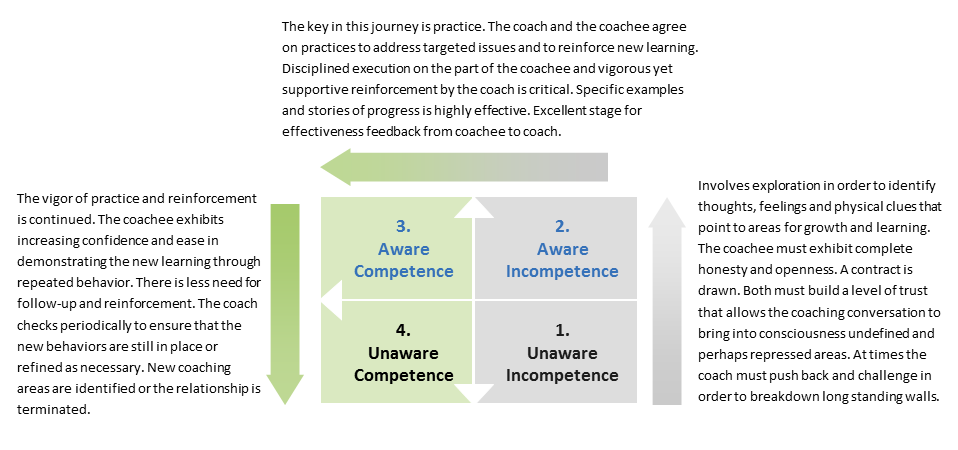
The journey from “Unaware Incompetence” to “Unaware Competence” and the corresponding coaching techniques outlined below is a useful framework for thinking about the coaching experience. Coaching is most successful when the leader becomes aware of his or her blind spots or areas for development and actively practices new behaviors.