Mindful Leadership – Part II

Most leaders report that over time, they lose the roots that connected them to their values and passions.  Like the experiment in which the frog does not feel the gradual rise in the temperature of the beaker and eventually dies, leaders slowly lose their values and authentic selves.  As they rise in the organization, they gain more power, status, and wealth.  The external world surrounding them rewards outward signs of success and wealth.  The social fabric that once judged them on who they were and held them accountable now gives them a pass.  They are treated in special ways and are exempt from the normal codes of behavior that others are judged by.  Their sense of self-worth is validated through their status, power, and wealth.  In addition, the excessive time spent at work with colleagues and the addiction to stay connected to work-related issues blurs and destroys the healthy work versus home separation required to recompose and build resonance.  In private rooms and confidential conversations, it is not unusual for me to witness depression, addiction, burn out, tears/despair, broken lives, extreme loneliness, and spiritual and emotional bankruptcy.

The road to recovery is a slow and deliberate journey.  It starts with the leader surrendering and admitting that he or she is unfulfilled and asks for help.  This seems obvious.  However, many have practiced the art of deceiving themselves and others.  Their public persona shouts confidence, positivity, and inspiring leadership.  The ego that is now addicted to the worldly signs of success resists interventions aimed at change –  change that may require more time and focus away from work and working hard to build real, rewarding, and longer-term relationships – which can get them back to their core values, principles, and authentic selves that made each special.  The ego will demand status quo and create fears of being left behind, losing privilege, or losing the attention of powerful people.   Bill, the leader described in Part I of this posting finally admitted that he was unfulfilled and on the verge of a breakdown.

The next step requires the leader to engage in a disciplined process of self-reflection and examination in order to achieve meaningful insights.  Bill committed to our every two week, one hour session, and to calling me on an unscheduled basis if needed.  He committed to regular reflection and introspection, and to talk openly with his wife about his fears and insecurities, and to ask her to remind him of the person she had married to help him create conditions that would rekindle their original connection.

The leader must be ready to look at different perspectives and competing agendas and to make trade-off decisions that will better align them to their core.  Bill declared his working hours to his colleagues.  He told them that unless there was a real emergency, he would not be returning their emails or phone calls during the weekend or while on vacation.  He encouraged his team to do the same.  He spoke to his supervisor and explained that while he realizes that cutting back on travel may have consequences for his career, he was willing to take that risk.  Bill told him that he thought spending more time at home and using technology rather than in-person trips may actually improve his productivity and creativity.  To Bill’s surprise, his supervisor told him that it was his call and he would be judged as anyone else at year-end based on results, and not how he got there.

Finally, the leader must commit to practicing the new behaviors and to ask for help if he has difficulty following the regiment.  Real learning occurs only if it is practiced.  The brain literally creates budding neuro pathways for the new behaviors.  The new pathways compete with well established routines that have been long rewarded and therefore easier for brain to access.  It is only through repeated practice and reinforcement by the leader’s support system that these new behaviors take more permanent and sustainable form.  Bill and I talked regularly to focus on his progress, emotional barriers to practicing his new self, and ways to normalize the enormous challenges inherent in achieving longer-term behavioral change.  Bill’s wife was enormously helpful in providing emotional support, as well as guiding him to rediscover his authentic self, which was what had made him so attractive to her when they had first met.

Leaders are human.  They enter the work environment with inordinate passion, creativity, and purpose.  As leaders rise in their organizations, it is critical that they find support systems that regularly help them remember their core values and the unique gifts that led to their success. They remind her of who she is and what she stands for.  They provide a safe environment for her to share her vulnerabilities, hopes, and fears. They hold up a mirror that reflects how others see her, and they champion her as she tries challenging new behaviors that will fulfill her and make her a balanced and inspiring leader.


Questions for Online Conversation:

  1. Have you or others you know gone through the journey described in this two part series?
  2. What was it like?
  3. How did you address it?

Mindful Leadership – Part I

DalaiLamaI work with educated, sophisticated, well-travelled, and experienced leaders.  Many lead large groups of people and achieve amazing results.  However, I consistently notice that they expend significant portions of their energy on leadership at the work place, and minimize or outsource the role in their personal lives.  Many profess that their passion and the way they assess their sense of self-worth is related to the welfare of their families and their role/contributions to it, and fostering deep and long-term relationships are paramount to their happiness and well-being.  However, when the conversation focuses on energy expended or commitment to success in these areas, it becomes obvious that their actions don’t necessarily support their words. By and large, they have scant knowledge of child psychology/development, and they spend little time reading and becoming more accomplished in human relations and powerful conversations.  Many see areas relating to emotional and social competency as important, but they are areas they may compromise given their busy lives and work commitments.

I recently spoke to the spouse of a leader as part of the interviews I was conducting in order to coach him.  He told me that his family is the reason he works so hard and wants to succeed. He wants to provide for them and ensure that he shares a long and prosperous life with his wife, described as his long-time sweetheart.  Not so surprisingly, I had expected that his wife would describe him as a rare example of a C-suite executive with the ability to leave work behind when he entered the house; someone who was present and mindful during their time together; aware of what is important to her and the children.  I had visualized that he would go out of his way to make her and the children feel special, notice the little things that she did on a day-to-day basis to support him and his family, and show appreciation and do things that would in return really lift her spirit and be important to her.  In fact, I found out that my client could not turn off work and was absorbed by it.  His wife told me that she is often frustrated by his poor listening skills.  “Sometimes, I feel like I have to shake him on the shoulder to get him to be with us…”  She felt there was no separation for him between work and home, and felt like most of his colleagues at work were with them in their house every night.  “He talks and obsesses about them as if they are members of our family, and knows more about them than he knows about me and the children.  I can’t help feeling like we are taken for granted…”  She admitted that he does all of the nice formalities – holiday, birthday, Valentine’s, and anniversary presents and cards.  However, they felt to her like rituals since his conversations and level of curiosity were superficial.  He seemed not to care how she really felt or what it was like for her to juggle and balance the multiple areas of their life.  He seemed to outsource their family and friends to her and to follow suit, rather than being an engaged partner with her.  Not surprisingly, she told me that his teenage son only told him what he wanted to hear – how well he was doing in athletics, how popular he was, etc… Their elementary school-age daughter would not even bother to talk to him about anything of substance and saw him as an easy target for funding things she wanted to buy.  Both thought it was “cool” that they had a rich dad, as it made it easier for them to achieve social status in their schools.

As the coaching progressed and he started to trust me, he revealed that he felt lonely and unfulfilled.  He does not really open himself up to anyone because most of his time is spent at work, and he does not trust his colleagues with his vulnerabilities.  He said that he did not feel “whole” because he expends great physical, psychic, and emotional energy on work and on his team, but every time he feels like he is accomplishing something or getting close to someone, things within the organization change. The organization is re-organized, a project is changed or discontinued, or people are leaving or coming into the organization. This leaves him empty and he feels like he is on a treadmill that keeps on getting faster and faster, but not leading to anywhere.  He then starts to regurgitate what he could do, why certain things happen, and why so-and-so said this or that, and he just cannot turn it off when he gets home.  He told me there is just not enough of him left for his family.  “It’s not that I don’t care or love them.  They are my whole world.  I just feel like there is nothing left.  I just can’t get the gremlins from work to stop talking…”

I wish he was the only one, or just one of the few.  Sadly, this leader represents the norm at this level in an organization.  The advent of electronic gadgets such as smart phones and tablets has only exasperated the extent to which my clients feel unanchored and out of balance. They are reliving the past or planning the future, but never really being present with their “whole” self.  They are failing as leaders in the most important arenas of life – being a father, a partner to their spouses, using their skills and presence to make a difference in the world, and serving as role models to those with less privilege, education, social capital, and influence. 

In the next posting I will share my thoughts about the work leaders need to do to get reconnected to their values and core essence.  I will update you on the work that the leader discussed in this blog is doing to rediscover his “whole self”.


 Questions For On-Line Conversation:

  1. How would you coach the leader discussed in this blog?
  2. What are you doing to reconnect with your values and whole self?
  3. Do you have examples or stories that can provide further insights?

Leadership In a Vacuum

Our U.S. culture is consistently assessed as one of the most individualistic and masculine cultures in the world1. This means that our tendency is to give too much credit to the leader when things go well, and to place too much blame on the leader when results are not achieved.  However, in my work with leaders and their organizations, I continue to be amazed at the frequency with which organizations fail to create an environment that enables these talented leaders to succeed.

Most organizations do not proactively think through their current decision making, governance, portfolio, human resources, structures, and other aspects of their culture prior to investing in hiring seasoned and expensive talent.  Instead, they determine that a proven leader with experience and expertise will quickly diagnose issues, develop alternatives, secure approval, marshal the necessary resources, and achieve goals. This fallacy of leadership is expensive, disruptive, and de-motivating.

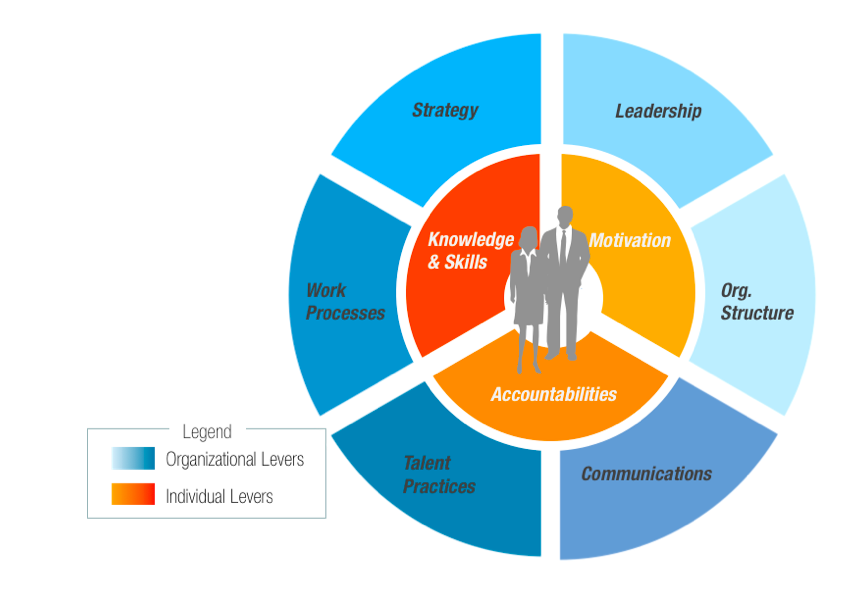
The chart below describes a holistic view of culture change.  Please note that leadership behavior is only one of the key levers that can be used to achieve an organization’s vision.

PIB Culture Wheel

Turnover costs are estimated at 25% of executive salary, plus benefits.  The cost of replacing a failed C-suite executive can easily be $1 million to $3 million2. New incumbents typically leave organizations where they have formed important relationships, gained lucrative salaries/benefits, and become comfortable with familiar cultures, to start a new position in a new organization with high levels of exuberance and energy.  They step into new surroundings that are unfamiliar to them and are rife with organizational and political landmines.  Consequently, it is critical for hiring managers and organizations to think proactively and reconfigure outdated and dysfunctional cultures, lest the new hire lose her motivation and reach levels of frustration that will result in low productivity and in higher doses separation.

A large pharmaceutical organization has invested significant energy in aspiring to change its culture to resemble “bio-tech” organizations.  More specifically, it has declared that in the future, its leaders should exhibit the following behaviors, among others:

  • Risk-taking
  • Accountability
  • Enterprise mindset
  • Openness and transparency
  • Patient-focus, including the ability to speed up decision-making by eliminating bureaucratic and unnecessary processes

A number of new employees were hired from bio-tech organizations, academia, and other large pharmaceuticals in order to accelerate this change (throwing talent at the problem).  These leaders report significant frustration and dismay at what they perceive as a broken promise.  They have experienced organizations bloated with complex and slow processes, and leadership teams that publically espouse the new vision but are resistant to meaningful change.  For example, when new scientists have more creative and “out of the box”  new product ideas,  they are told to continue to follow the traditional portfolio allocation and new product development processes with stage gates that are based on more conservative and traditional hurdles.  They find that they are not able to voice their own ideas in front of senior mangement.  Travel and outreach to the external scientific community is restricted through cost-control measures that have to be cleared at the highest levels in the organization.  In one case, a renowned scientist experienced a significant delay in getting approval for a trip to Europe where she was asked to present to a senior scientific audience. Significantly, these leaders were promised that they could hire and bring new and more innovative talent into the organization.  In reality, they discovered that separating low-performing existing talent required a lengthy and bureaucratic human resources review and approval process.  In addition, the cost-control measures prohibited them from adding new headcount.

Not so surprisingly, a number of these leaders are frustrated, feel underappreciated, lied to, and unproductive.  As a result, the organization is in danger of losing these leaders. The hoopla behind the “bio-tech” culture has taken a back seat to quarterly targets, Wall Street analyst projections, and defensive legal maneuvering to prolong the life of expiring patents.

Organizations should think clearly and proactively prior to hiring senior talent.  They should conduct an honest “change readiness” exercise that paints a detailed picture of the future and assesses the readiness of the senior management to change its beliefs and behaviors.  Management must go on record and commit to these changes prior to making the hiring decision.  One clear indicator, and one that I encourage my clients to pursue, is the wording of the announcement letter introducing a new hire.  The announcement letter should not only communicate the background and qualifications of the new hire and the level of excitement of the receiving organization, but equally the specific changes that will be put in place and the level of authority that the new hire will enjoy. For example, a more streamlined reporting and decision making process or the ability to hire up to X number of new people and to restructure the organization as he/she sees fit.  Furthermore, organizations should invest in a thoughtful on-boarding program and transitional coaching in order for the new hire to be able to adjust to the new surrounding in a way that is natural, and help avoid early mistakes that could establish longer-term negative perceptions.

In short, the challenge for leaders as they acquire and on-board new talent is to ensure they are not leading in a vacuum, but preparing their grounds for new talent. The ability to understand an organization’s culture, articulate it to prospective leaders, and actually live it on a daily basis is the cornerstone to creating an environment that enables leaders to succeed.

Questions For On-Line Conversation:

  1. How should organizations prepare the grounds for new talent?
  2. What are the biggest obstacles and blockers?
  3. What are your recommendations?

———–

1. The Hofstede Centre. http://geert-hofstede.com/united-states.html. Accessed February 3, 2014.
2. Byrnes, Nanette and Kileyy, David. “CEOs: Hello, Your Must Be Going.” BusinessWeek. 11 Feb. 2007.

Year-end Reflections

More than at any other time in my 35+ years of business experience, I have noticed the profound challenges leaders face in honoring their soul (or North Star as I prefer to call it) while performing their roles of stewarding the financial success of their organizations. 

Today, more and more leaders are hearing competing voices dominating their inner conversation in hopes of tipping the balance of power. Through my personal one-on-one executive coaching sessions, I often work with clients to reconcile these tensions. Below are a few of the more frequent, compelling, and often times, simply gut-wrenching inner discussions that leaders face.

(1)   Nurture vs Performance – Often times, leaders struggle with the challenge of balancing the fulfillment that comes from nurturing, teaching, and mentoring employees, and enabling them to reach their potential, which is often at odds with the performance orientation that exists in many organizational cultures. Organizations espouse that talent and their commitment to their employees are their greatest distinguishers; however, this message is not carried though in practice.  Often when the “real business” conversations commence during operating plan reviews or presentations to boards, leadership styles that are more caring, emotional, and less aligned with rational, objective, and efficient styles are perceived as “risky”.

My clients confess that during these times of high pressure, they often feel bulldozed and even violated, but find themselves feeling helpless and paralyzed by fear and anxiety.  On the one hand, they intuit that not speaking up or acting on behalf of their organizations is violating their pledge as servant leaders. On the other hand, they worry that they may be labeled as “too soft”, “wearing their emotions on their sleeves”, “not able to make tough decisions or have difficult conversations”, and subject to a litany of other judgments that may jeopardize their hard work and careers.  One of my clients reported that her sleeping, eating, and general wellness was compromised for weeks as she watched a consultant, selected by her organization’s President, force individual team members to publically, and in the most direct manner possible, tell others what they did not appreciate in them.

Needless to say this exercise in “courageous conversations” backfired, and my client felt resentment and an unsafe environment for weeks after the workshop.  She felt she had abandoned her soul by sitting back and watching the exercise unfold and not speaking up.  Her intuition, upbringing, and values were demanding that she stop the exercise and point out the destruction she and others were experiencing. However, she felt straight jacketed by her organization’s culture that whispered “you will be seen as too soft and not a team player”. In short, this real tension of bringing out one’s heart and nurturing side is often perceived to be at odds with being able to generate results and perform at a high level.

(2)   Personal vs. Professional Relationships – My clients often report that they feel pressure to relate to their work colleagues in a narrow and “professional” manner. However, it turns out that this prism is a robotic and unfulfilling one.  Organizations are not well-oiled machines as some prefer, but a tapestry shaped by human fabric made up of aspirations, fears, anxieties, courage, and numerous other feelings.  In addition, the multi-cultural and multi-generational workforce of the 21st century brings with it a litany of beliefs, cultures, and mindsets. Given that in the U.S., more than 70% of our waking hours are usually spent at work, it would only make sense that we get to know our work colleagues as “whole people” and not as functionaries of their organizational roles. Connecting to others is a basic human need like food, shelter, and physical safety.  When we are forced to abandon this basic human impulse in favor of artificially classifying, categorizing, and judging others, we feel unfulfilled and react in unnatural and destructive ways that may harm others and ourselves.  Getting to know the whole person also makes business sense.

In a recent survey conducted by Rath, Conchie, and a Gallup research team asking more than 10,000 followers what they need from their leaders, they consistently pointed out four areas:

  • Trust
  • Compassion
  • Stability
  • Hope

Notice that these four needs are realized when the leader is able to connect with her followers at an individual level and when they get to know her as an authentic and real person. It is nearly impossible to trust, feel compassion, and invest our hopes in someone whom we don’t really know or connect with. In short, the tension lies in the desire for leaders to be authentic in cultural environments that often times penalize them for doing so.

(3)   Whole Self vs Work SelfWork is a natural and healthy calling. It validates our evolutionary need for productivity and achievement. It is noble and honorable to create better and safer products and improve our societies. However, extensive research on happiness and wellness confirms that work comprises only one of our basic human needs. Leaders are under increasing pressure to borrow from other parts of their lives and invest more time, focus, and energy into work. Many leaders report symptoms of burnout, depression, sleep deprivation, weight gain, drinking, and other unhealthy outcomes. Extensive research documented in “Resonant Leadership: Renewing Yourself and Connecting with Others Through Mindfulness, Hope, and Compassion” by Richard Boyatzis and Annie McKee shows that rather than constantly sacrificing themselves to workplace demands, leaders must be resonant–combat stress, avoid burnout, and renew themselves physically, mentally, and emotionally if they are going to be able to successfully lead others. In short, this core leadership dilemma lies in the need for leaders to be more balanced, while operating in organizations that often do not provide them the time to do so.

Questions For On-Line Conversation:

  1. Are you facing any of the above mentioned dilemmas in your leadership?  How are you managing them?
  2. Are there other competing forces that you think leaders are challenged by?

——–

1. Rath T, Conchie B. Strengths Based Leadership: Great Leaders, Team, and Why People Follow. New York, NY: Gallup Press. 2008.

2. Boyatzis R. McKee A. Resonant Leadership: Renewing Yourself and Connecting with Others Through Mindfulness, Hope, and Compassion. Boston, MA: Harvard Business School Publishing. 2005.

The Greatest Leader

I have been thinking about ways to bring together many of the thoughts and ideas that I have posted over the past two years.  The passing of a man that I consider the greatest leader of all time, Nelson Mandela, reminded me that he embodied them all.

Nelson Mandela was the perfect balance of the feminine and masculine energy. In his zeal for independence and hate for apartheid, he exhibited many of the traits typically attributed as masculine: courage, resilience, drive, focus, decisiveness, and results-orientation. In his preference for reconciliation rather than rancor and revenge against the Afrikaners, he decided to build a rainbow coalition, and exercised qualities typically attributed as feminine: expressive, emotions, tenderness, relatedness, love and compassion, imagination, gentleness, creativity, intuition, and harmony. This aspect of his leadership is one of the most important reasons for the peaceful transition of South Africa from the apartheid regime to majority rule.

He was the ultimate reflective leader. Twenty seven years of prison provided him ample time to reflect and learn. In prison he learned the language of the Afrikaner, his culture and mores.  He realized that the journey to reconciliation started with understanding your adversary.  His reflections allowed him to piece together his strategy for the rainbow nation and ways of moving Afrikaners into nation-building.  After his liberation, he continued to take his nightly walks alone to reflect on his day and to capture the learning.

Mandela was the personification of an authentic leader. He made his values and beliefs transparent and his actions supported them.  For example, when it was discovered that Winnie, his lifelong soul mate who stood by him throughout his prison years had misused her power, he stripped her of power and eventually left her.

He was the giver leader. After he stepped down from presidency, he spent most of his time in the service of children with grave illnesses and AIDS. He travelled the world for peace and harmony, and because of his credibility and stature, was able to influence numerous world leaders to better the human condition.

Mandela understood the power of words and the impact of humor.  Those that heard him were moved by his words, which were often spoken with conviction and the wisdom that comes with years of suffering and reflection.  His words resonated with people across the globe because he understood his audiences and took special care to connect with each at their level.  His informal style and humor made him approachable and liked.

We have lost one of the most inspirational and exceptional leaders our planet has known. In dedicating this posting to him, my sincere wish is for my readers to reflect on the actions of this great man. Hopefully, each of you can reach deep inside yourselves to access the leader attributes that are awaiting discovery and to be carried out in the service of those that have entrusted their lives and careers to you.

Crisis Leadership

Challenging times, such as the ramifications of the recent impasse over the government budget and debt ceiling, provide exceptional opportunities for great leaders to emerge. Typically these situations create a leadership vacuum as the incumbents scurry about looking for safe heavens or for ways to protect their turfs and interests, rather than serving the broader constituencies that bestowed to them their position and power. It is now clear that the leaders of some of the largest financial institutions were actively betting on the failure of some of the same instruments that their firms were marketing in order to hedge their organizations and positions. However, there is another breed of leader that sees crisis as an opportunity to demonstrate their leadership effectiveness. There are common traits that seem to define this brand of leadership

Belief in Servant Leadership—these leaders believe that the mantle of leadership has been bestowed on them so that they can serve others.  They believe that the leader’s most important job is to serve those that have entrusted them with the power and privilege of leadership. Their actions are often powerful demonstrations of this principle.  Pope Francis’ public declarations of support and care for the under privileged and poor, and his decision to expand the doctrine of the Catholic church to encompass a broader coalition of beliefs and life styles, is an inspirational model of servant leadership.

Longer-term Vision/ Perspective—these leaders understand the urgency of the situation, but are not prepared to make quick and reflexive decisions that would temporarily relieve the situation whilst creating even bigger problems in the future.  Instead, they strive to strike a balance between current recovery and strategies for future greatness.  The new leader of a pharmaceutical organization, which was put under the Consent Decree by the FDA for manufacturing safety issues, decided that there would be two streams of work to address the issues. One team was responsible for quick fixes, while the other team’s task was to determine how the organization could transform itself so that it could be seen as the benchmark of safety for the industry.  Prior to approval, the leader insisted on ways to integrate both quick fixes and the longer-term recommendations.

Ability to Identify Talent and Build Coalitions—the crisis leader finds himself short of time and with enormous challenges that require urgent action.  These leaders have a tendency to quickly locate the right talent, and empower them with the support, resources, and authority to make a difference.  When the CEO of Chrysler, Sergio Marchionne, took over the reign in 2009 in the midst of one of worst recessions in U.S. history, he inherited a company that was on its knees.  He quickly exited the old guards who were protecting the past, elevated the creative and energetic high potential talent to key positions, and relocated his own office and attention away from the executive suite to where the products were conceived and manufactured.  The results speak for itself, with Chrysler reporting consistent increases in net revenue since the federal bailout.1

Learning Mindset—Crisis leadership requires a learning and growth mindset that allows the leader to change course with new information, and to acknowledge mistakes in order to quickly reverse course and adopt a more appropriate strategy.  The leader who steps into a challenging situation is often faced with a dynamic situation where there are many moving parts already in motion.  Quick and timely action is required.  Consequently, it is unrealistic to assume that every decision that she makes will result in successful outcomes.  However, if she is able to quickly absorb the learning and integrate it into the next strategy, she distinguishes herself from many leaders who are reluctant to change their publically stated positions, even in the face of mounting evidence of the need for change.  In 2008, Ben Bernanke, the outgoing chairman of the Federal Reserve, found himself having to lead U.S. economy out of one of the worst recession in its history.  The financial crisis, spurred by the housing crash, halted the financial markets.  Bernanke and his team quickly resolved to introduce a battery of new instruments designed to supply needed cash to banks so that they could lend to businesses and consumers. The short-term, interest rates were brought down to near zero percent and the Fed embarked on an ambitious plan to purchase Treasury bonds and mortgage backed securities so as to lower the long-term interest rate for home buyers and others. As Michael Gapen of Barclay Capital told USA Today, who at the time worked closely with Bernanke and his team as the head of the monetary affairs at the FED, the implicit philosophy of Bernanke was “let’s try it and see if it works, and if it does not, let’s try something else.”2


1. CNBC. Chrysler earnings jump 16%, give boost to Fiat.  http://www.cnbc.com/id/100921458.
2. USA Today. October 10, 2013.

The Humorous Leader

“Next to power without honor, the most dangerous thing in the world is power without humor.” – Eric Sevareid

My client was a member of a leadership team reporting to Jim, a hard-charging, results-oriented leader who delivered a direct punch when he thought it necessary.  The operating plan reviews were viewed as an especially stressful time, with members of the leadership team presenting the performance of their businesses. It was not uncommon for Jim to pass judgment and admonish team members publically.  My client’s business experienced a difficult year, as several of his long standing contacts had either retired or transitioned to other roles.  Their successors had decided to place their accounts with their own preferred vendors.

Needless to say, my client was concerned and anxious about his upcoming review.  However, he carried abundant charm and a disarming sense of humor.  He presented himself at the appointed time for the operating plan review meeting carrying a small bag that no one paid attention to.  It was a brutal meeting, and Jim was in a feisty mood as the organization had underperformed and he had an analyst tele-conference confronting him the following week.  He let his displeasure be known to all and publically derided the presenters.  When the person to my client’s left started his presentation, he excused himself and left the room.  He went up to his hotel room to change into a new outfit.  He came down to the conference room where the reviews were being held, stood outside, and opened the door slightly so he could hear the proceedings.  When he heard his colleague finish his presentation and it was his turn to speak, he heard his colleagues asking where he had gone and whether they should proceed without him.  At that moment, he entered the room wearing a bullet proof vest and other protective equipment from head to toe and carrying a white flag in one hand and a sign in the other saying  “I am sorry boss, I promise to do better next year…”  The room exploded with laughter, and the tension that had been felt so intensely just prior to his entry suddenly started to melt.

Well-placed and effective humor is a powerful ingredient of leadership.  In my client’s case it was used to diffuse dysfunctional tension and to create a different and more productive climate.  There are many other ways that humor can serve a leader.  Outlined below is a partial list.

  1. Humanizes and makes the leader more approachableIn particular, self-deprecating humor can go a long way in making the leader appear genuine, reachable, and likeable.  Warren Buffet’s sense of humor has helped frame him as a leader who is an everyday kind of person, genuine, approachable, and believable.  His disarming and down-to-earth humor is exemplified by quotes such as “I buy expensive suits, they just look cheap on me” or “you only find out who is swimming naked when the tide goes out”.
  2. Affords an opportunity for the leader to role model behavior that creates a positive and high performing culture/team – Too many leaders confuse great leadership with astern seriousness, lack of emotion/feelings, and a brand of “just the fact please…” that disconnects them from their followers. Daniel Goleman and Richard Boyatzis ground breaking work on emotional intelligence show that our brains carry a number of “mirror neurons” that function to mirror or mimic what another person is doing.  So in a sense, followers often quite literally mirror what their leaders do.  Or as they state “ A boss who is self-controlled and humorless will rarely engage those neurons in his team members, but a boss who laughs and sets an easygoing tone puts those neurons to work, triggering spontaneous laughter and knitting his team together in the process. A bonded group is one that performs well, as our colleague Fabio Sala has shown in his research. He found that top-performing leaders elicited laughter from their subordinates three times as often, on average, as did mid-performing leaders. Being in a good mood, other research finds, helps people take in information effectively and respond nimbly and creatively. In other words, laughter is serious business.” 1
  3. Effectively communicates a message in a manner that is memorable and lasting – For example, during a St. Patrick’s Day reception, president Obama was presented with a certificate of Irish heritage by the Irish Prime Minister. “This will have a special place of honor alongside my birth certificate,” Obama deadpanned, hinting at the on-going conversation of his citizenship.

Humor must be used with judgment and discretion.  Ill-advised use of humor can result in serious damage to the leader’s reputation.  Examples include:

  1. Humor that is insensitive or offensive to a group of people – Typical examples include sexist, racist, and patronizing comments.  For example, the former Italian Prime Minister Sylvio Berlusconi, in response to allegations of a philandering life style, replied “It’s better to like beautiful girls than to be gay.”
  2. Humor that is out of context with the environment or cultureDuring President Bush’s speech at a White House Correspondents Association dinner in 2004, he narrated a slide show that included a photo of himself hunting around in the Oval Office. He went on to say, “Those weapons of mass destruction gotta be somewhere.”  This was seen by many as being insensitive to the military personnel and their families making the ultimate sacrifice for their country, under the false premise of the existence of weapons of mass destruction.
  3. Humor that is badly timedFor example, a leader I was working with had a nervous habit of making jokes as ice breakers. This habit was not received well in overseas cultures where it takes longer for relationships to progress to a point where one can joke or use puns.

Questions for on line conversation:

  1. How have you used humor in your leadership presence?
  2. What have been the results?
  3. What are some of your thoughts and suggestions in this regard?
1. Goleman D, Boyatzis R. Social Intelligence and the Biology of Leadership. Harvard Business Review. September 2008.

Guest Posting: Leadership Communication

Note from Kaveh: Periodically I invite thought leaders and practitioners who have done important work in the field of leadership to contribute as guest writers. Such is the case for this posting. Paul Black is a former actor and an accomplished leadership practitioner with a particular expertise in the area of communication effectiveness and executive presence.  We have worked together on several coaching assignments where one of the presenting issues was communication effectiveness and executive presence. Paul is one of the leaders in the leadership and coaching practice of my company, Philosophy IB.

==========

Leadership Communication
by Paul Black

“The art of communication is the language of leadership.” – James Hume

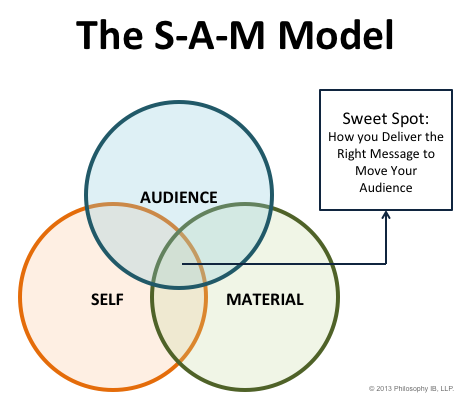
The goal of any communication, other than the most social, is persuasion: to move your audience to think, say, and ideally do something different. As a leader, you are constantly trying to move people to the action that serves your objectives, and the more mindful you are about it the more success you will have. The wide array of communications you will undertake in a given week (from one-on-one meetings to large presentations) are all opportunities to persuade.  You will benefit from a systematic approach to thinking about and executing these interactions. What follows is an introduction to an approach which I have called the SAM Model:

SAM-Model
At the center of the three interlocking circles is your ‘Sweet Spot’, where YOU (Self) deliver the RIGHT MESSAGES (Material) that move your AUDIENCE in the desired direction. This model applies to all and any interactions, from one-to-one conversations, to small group meetings, to large group presentations, to broadcast communications. The principles apply in each scenario in different proportions dependent on the specifics of the interaction.

With each of these elements, it’s important to recognize that you will have some natural tendencies that you will want to lean on, and some that you will need to work around. Since we have been communicating since birth, we’ve learned a lot of habits, not all of which are helping us. By raising our awareness of them, we can begin to be mindful about what we choose to use and what we need to develop.  In addition, we can choose a sub-set of specific elements to lean into or emphasize for one type of interaction, and a different sub-set for a different scenario.  In other words, what works well with a peer at a power breakfast, might not work so well with the C-suite in the afternoon. As with all personal development, mindfulness is foundational. Let’s take a closer look at each other three elements of SAM to understand them better.

AUDIENCE

I start with the audience because that’s where you should too.  It is easy not to do so, but to preclude this thinking is a fatal error.  Many individuals get so caught up in their own agenda that they forget to engage in adequate thinking about their audience.  You need to develop an understanding of and connection to your audience.  Preparation here is crucial.  Ask yourself the following two fundamental questions:

  • What does my audience WANT?
  • What does my audience NEED?

Make sure you know the difference. Here’s a simple example:  if my friend takes me out to lunch, and suggests “You need a healthy salad,” I’m much more likely to agree if I can get some of what I want (bacon bits in the dressing), and I’m much more likely to think it was a great experience. Balance out both Wants and Needs in your interaction, and you’ll set yourself up for success.  Speakers fail when they confuse their own objectives with the Wants and Needs of the audience – don’t make this mistake.

MATERIAL

You can now begin to develop messages that will service both your audience’s Wants and Needs as well as your objectives. Some considerations here include:

Clarity of objective: Write out a clear one sentence description of your interaction. It will:

  • Define your purpose
  • Focus your energy
  • Provide you the only true measure of success

Structure and Flow:

  • Have a robust structure with a beginning, middle and end
    • Start: tell them what you’re going to tell them
    • Middle: tell it to them
    • End: tell them what you just told them.
  • Obey the “Rule of Three,” for example, three messages per slide
  • Use stories and personal anecdotes to add flavor and color

Visual Aids:  You have three tools in your content tool box. Ensure you think adequately about each:

  • What the audience SEES
  • What the audience HEARS
  • Your NOTES (it’s OK to have then, but they are not a substitute for practice!)

SELF

Finally we turn to you and the elements of your physical being and persona that you can control to bring success to your interaction. There are three buckets here:

Mindset: A critical piece that is often overlooked by the busy leader who believes she can “wing it” and succeed.  She often can, but she’s flirting with danger and may be courting disaster. Considerations include:

  • Clear articulation of success: write it down and use it to vision success.  Be crisp and precise
  • Imaging: pick a role model you admire and think about how he or she would do it….what can you learn from that person?

Vocal Quality:  I coach leaders who are told “…we can’t hear you…” or “You’re boring.”  The basic tools available to all of us are:

  • Volume
  • Rhythm (speed, or rate of delivery)
  • Clarity (enunciation)
  • Pitch (musicality or tune)
  • Style (e.g. didactic for credibility; conspiratorial for humor)

Physicality: This is most evident when a leader is presenting on her feet and needs to figure what to do with her hands, her feet, etc. Some simple considerations are:

  • Body language:  Understand your non-verbal vocabulary and use it mindfully because your audience is interpreting it constantly
  • Gestures:  make them genuine and fluid
  • Movement:  don’t hide behind a lectern, desk, or other physical object – add a little bit of flavor with some thoughtful movement to pique the audience’s interest

While the SAM model is simple, it is robust enough to be used in any interaction where you are communicating with substance.  It provides a useful framework to dissect the question of how to best communicate in any set of circumstances.  I have used it effectively in my coaching work with leaders to assess where their natural strengths are and where they need to spend some additional time preparing for their interaction. Here’s an example to illustrate:

REAL WORLD APPLICATION:  A Senior Vice-President wins over the Board

Steve was a successful SVP at an insurance services company, and unofficially, the successor to the CEO who was grooming him. The CEO, however, was fully aware that Steve had some career-limiting blind spots. In working directly with Steve, we assessed that he was technically brilliant, knew the industry and business intimately, and could lead his people from a place of intellectual superiority.  One of Steve’s challenges was interacting with the boardroom, who chaffed under what they preserved as an air of arrogance and “know-it-all-ness.”  The CEO was not blind to this and knew that his succession plan hinged, in part, on a shift in Steve’s ability to influence the board, without whose good grace he could never succeed.

We identified an opportunity where Steve would be making an important presentation to the board to request funding for a series of initiatives that under-pinned a large part of his operating plan for the following 18 months.  This would be no push-over presentation. The board would scrutinize his plans and could easily hold back funding for a wide variety of reasons, including, to put it bluntly, “not liking his attitude.”  To increase the stakes, this kind of presentation only happened at most once a quarter, and with such a tight agenda, he might not get a second bite at this cherry for 6 – 9 months.  Without a clear approval of funding for his initiatives, his operating plan for the next fiscal year would be in jeopardy, along with the CEO’s succession plan.

We met with Steve several days before the board was due to convene at a private ranch in Arizona. We set up a video camera with playback options so Steve could self-assess and we could work with him to make any necessary modifications.  However, it quickly became apparent that the technology was redundant, for reasons I’ll explain.   Steve launched into his presentation, which was thick with the technical justification of why his requested funding was imperative. We had agreed beforehand that he would have about 15 minutes to present and would anticipate about 15 minutes for questions, but by the time the quarter-hour mark was up he was only about 1/3 of the way through his dense slide deck. We stopped Steve and began to lean into the SAM model.  What did his Audience Want?  What were their Needs? Were his messages crisp and clear?  Were his material / slides appropriate?  What was his mental attitude (coercive, or generous, or…what?).  Steve was a quick learner and quickly understood that he had to make some serious shifts.  After an hour of coaching and discussion he had a clear plan of what needed to change and how.  Despite his very busy SVP schedule, he committed to carving out the time before the Arizona presentation to re-visit the key areas we identified together….the ball was in his court.

When the presentation came, Steve, with a clear view of what his Audience Wanted and Needed, along with a new, leaner set of messages and a significantly altered mindset, stood up to make his case to the board.  We later learned that within two minutes of his starting to speak one board member discretely turned to another and whispered, “Something’s changed here…has he been coached?”   Steve’s presentation was a roaring success: the board funded all his initiatives for the following year.  His operating plan was now well positioned for execution, and the CEO’s succession plan appeared to be falling into place, which was good news for both the CEO and Steve.

Habitual Leadership (Part 2)

RoutinesIn the last posting, I presented the neurological framework of habits, described the auto behavior progression of cues—routines—rewards, and shared a case example loosely based on a coaching client (Sam) – a pharmaceutical R&D executive recruited from academia. Sam’s habits from academia were not aligned with the culture of his new employer, and therefore not rewarded.

In this posting, I will describe my experience in working with leaders on habits that interfere with their growth and success. The goal is to disrupt the dysfunctional habits, and replace them with new leadership behaviors that help them succeed at work and in life.

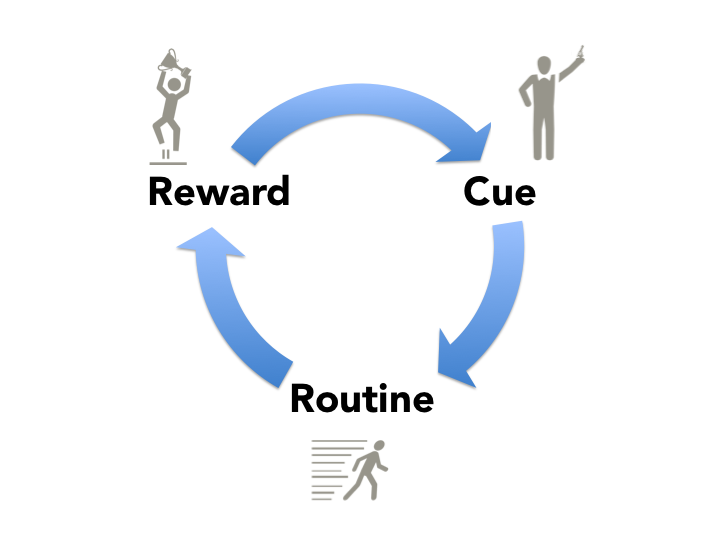
Theoretically, the dysfunctional habit can be disrupted by leveraging any of the three elements of the habit formation—the cue, the routine, or the reward.  For example, if a leader continually disrupts the flow of a leadership team meeting by responding to text messages, one can eliminate the cue—take away his smart phone so that he cannot see the incoming text messages. Or, we might change the routine that he defaults to—tell him not to respond to incoming texts. Finally, we can change the reward/recognition mechanism to discourage him from answering incoming texts—have the team exhibit the right behaviors and call out his behavior to remind him that he is not adhering to the team’s norms. Experience shows that more permanent behavioral change occurs when the leader chooses and takes accountability for the new behavior. That is to say that the change is self-generated rather than imposed from an external source.  In most cases, changes that are imposed from an external source have limited shelf life. They are effective as long as the external source can regularly inspect and monitor compliance, and can execute the consequences for non compliance.  In our example, the cue (incoming texts) and the reward mechanism (public admonishment for texting) are both external factors that surround the behavior of the leader. However, ultimately, it is the performance of the routine itself that is displayed and judged.  If the actor/leader’s auto response mechanism can be slowed down to the point where the leader is able to reflect and use judgment prior to acting, the habitual cycle can be disrupted.

In the last posting, I described the case of Sam, the pharmaceutical executive whose habits and routines from his days in academia were not productive in the new setting. Initially, our work focused on making Sam more aware of the perceptions of his colleagues, and the differences between the academic culture (where he had spend the first 20 years of his career) and the culture of his new employer. Once he became aware of the adverse consequences of his habits, he agreed to practice new routines that were more aligned with his new culture. For example, he spent more time networking and asking questions prior to making decisions.  In doing so, he gained a better understanding of the organizational dynamics and practices, such as ways to make requests for and secure additional resources. With this new understanding, our work focused on systematically changing his routines and habits in ways that were aligned to his new surroundings. Rather than unilaterally determining to pursue projects that he was passionate about, he spent time understanding the prioritization process that his employer used to determine which projects should go forward with additional clinical trials. With this new understanding, he became more adept at focusing his team’s efforts on areas of high priority for the organization. In addition, he coached the team to develop their ideas in a language and format that had maximum impact at portfolio review meetings. Naturally, it was not an easy task for Sam to break old habits. In fact, it took a great deal of perseverance and self-monitoring to change old habits. At first, the new ways of doing things felt unnatural and accompanied resentment for having to change practices that he had become so accustomed to.  The new behaviors felt uncomfortable, and did not feel authentic and natural for Sam. However, with repeated practice and patience, he gradually became more comfortable with the new habits, and in some cases, he somewhat reluctantly admitted that they were more effective than his old habits.

Questions for On-Line Conversation

  1. What has been your experience in breaking old habits? Were you able to break these habits permanently, or did you go back to them at some point? Why?
  2. How did you change your habit(s)?
  3. What has been the outcome of adopting your new habits?

Habitual Leadership (Part 1)

This is the first of a two part posting on habitual leadership. Part one will address the neurological basis for habit formation and the consequences of habits both positive and negative. We will illustrate these concepts through a real case (identities have been altered to safeguard client confidentiality). In part two (next posting) I will share ways to isolate and modify dysfunctional habits.

Part I
In the center of our brains close to where it meets the spinal column are the parts that have evolved over millions of years and that control much of what is known as the “auto behaviors.”  These include functions that are critical to our survival as species such as breathing and swallowing. Over time more complicated routines such as cooking a meal have been made into habits that require very little effort. Extensive research chronicled in “The Power of Habit: Why We Do What We Do in Life and Business” written by Charles Duhigg 1, shows that our brain is on a constant mission to use its energy in the most efficient manner possible. In other words, it is looking for ways to economize and if possible to convert as many of the decisions into routine habits as possible. This opens up space for the brain to address less familiar and more complicated computations and decision making. The danger of course is that if our brain switches channels pre-maturely, we ignore important information and/or critical nuances prior to turning on our auto response behaviors. We develop “blind spots” that prevent us from making the correct calls.

It turns out that our brain looks for ways to select amongst the cues and see which can be categorized as habits. The way that it selects cues has a lot to do with which routines have been rewarded. Furthermore, the routines that are most established and hardest to change are those where the associated reward actually satisfies a “craving”. For example, the sight of chocolate, chocolate craving and eating chocolate to satisfy the craving.

Routines

Habits Are Formed In This Way

  1. Cue – Incoming information
  2. Routine – Our auto response to the cue
  3. Reward – Positive response from our environment which connects with and fulfills part of our persona and overtime creates a craving

Leaders too have developed habits and often display reflexive behaviors. These behaviors are typically learned and practiced over their career and to the extent that they are rewarded they become part of the formula associated with their success.

Sam had been attracted to drug formulation because he found the science of discovering new molecules and formulary fascinating and fulfilling. Throughout his academic career he has been recognized as one of the most creative and ingenious scientists. Sam had perfected a routine for his work and research. He had come to understand what areas would attract the most interest from his peers and broader scientific community, how to write proposals and seek grants, develop an extensive and well recognized cadre of collaborators and knowledge network. He also knew how to position his projects and himself for the right venues and audiences. Throughout his academic career various pharmaceutical companies had been courting Sam to join their R&D organization and had dangled impressive titles and compensation. However, he remained indifferent to these offers. His freedom of thought and unrestricted collaboration with his network of thought leaders were more important to him than financial rewards. By the time we started our work together Sam was at a very different place. A global pharmaceutical organization had convinced him that they were in the midst of a transformational culture change that would make their organization look and feel like a more nimble bio tech. He was promised in no uncertain terms that he could continue to conduct his research in the same manner with unrestricted access to his network. He was promised significantly larger budget and unlimited access to the intellectual property of the organization. He was also promised to lead the culture change initiative and told that his background and external perspectives make him the ideal candidate for the role. After numerous courting sessions including several with the CEO and global head of R&D Sam relented and joined the pharmaceutical organization.

It was not long before Sam started to notice that what had made him successful in the academic setting was not going to be rewarded. For example whereas in the past he had been attentive to signals from the scientific community and focused his research accordingly, his new organization placed more importance on the perspectives of the business development and commercial organizations to determine where research resources should be directed. In his new environment open ended Socratic dialogue, which was his preferred approach to innovative thinking, was not respected as much. His colleagues seemed always to be in a hurry, shuttling from one meeting to next. They seemed to be anxious about having conversations and discourse that did not result in defined deliverables or next steps or that were not somehow connected to a cascaded set of goals that were supposed to connect and align the activities across all levels in the R&D organization. He was given feedback about his communication style. He was told that he did not carry executive presence and in fact he came across as too academic (a definite negative in this new setting). His request to release his budget and resources came under scrutiny. His supervisors wanted him to present the “business case” for these expenditures and were not impressed by his instincts and experience (for which he was hired in the first place). They told him that they simply could not expend resources based on hunches or discovery projects that were not backed up by the collective wisdoms of their pharmaeconomic and value proposition groups. And that these expenditures needed to be “on strategy” and have to be in areas that aligned with the portfolio prioritization process that the organization had put in place for allocating resources to projects. Prior to attending industry and academic knowledge sharing forums he had to secure approval from his supervisors and his presentations were now thoroughly reviewed by corporate lawyers and intellectual property experts to ensure that he did not divulge proprietary information. His former academic colleagues started to feel the difference in how Sam interacted with them and became more reticent in sharing their views and perspectives with him as freely.


[1] Duhigg, Charles. The Power of Habit. 1st ed. Louisville: Random House, 2012.

Questions for On-Line Conversation

  1. What leadership habits have you formed over the years that are no longer serving you?
  2. What are/were the cravings behind your habits? ( how did it satisfy an important need in you?)
  3. How are/have your habit been rewarded?
  4. How would you coach Sam at this point?